
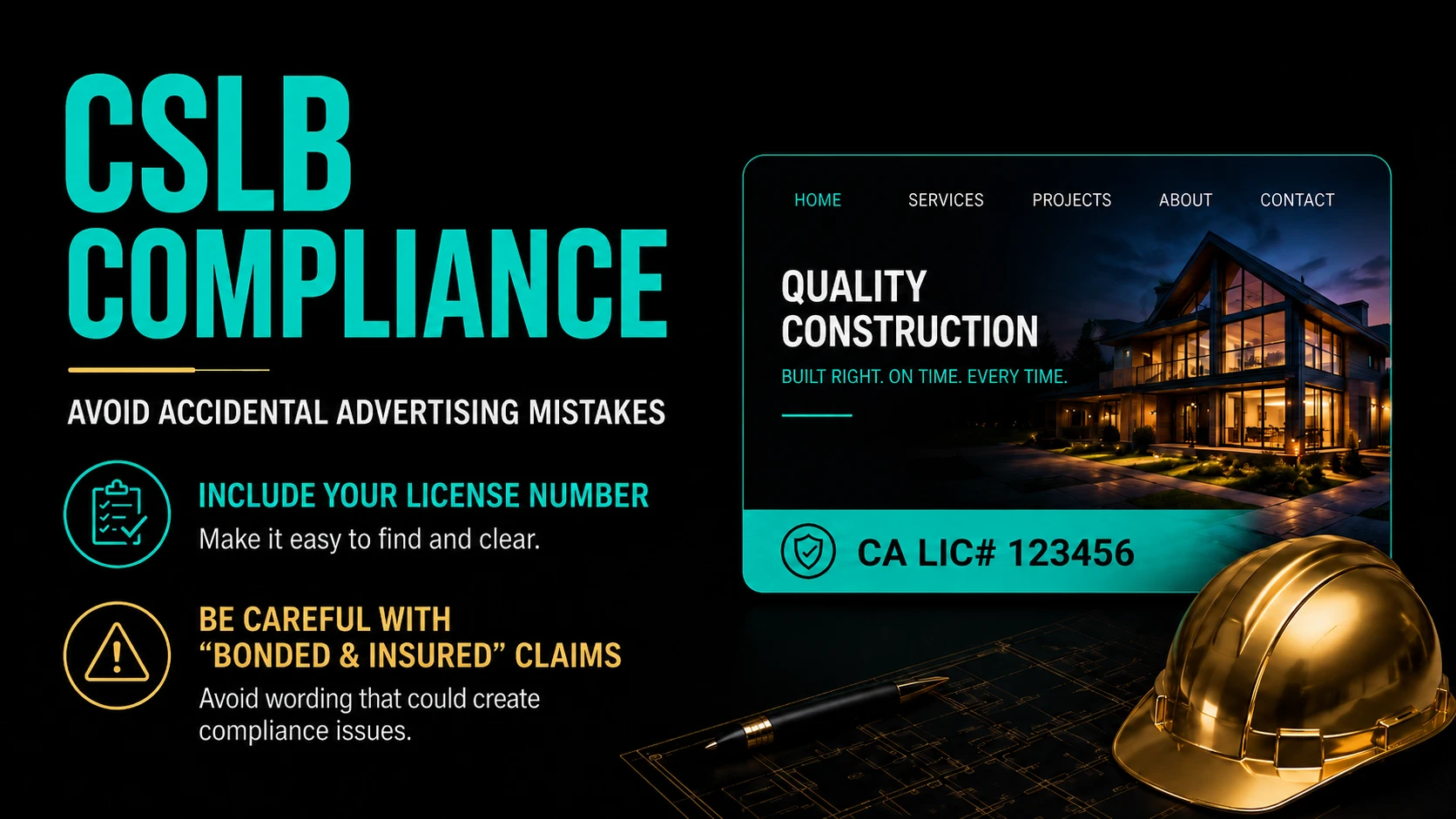
What California Law Prohibits in Contractor Advertising
- Claiming you are "bonded" — prohibited under BPC §§ 7071.13 and 7027.4. Any reference to a contractor's license bond in advertising is grounds for license suspension.
- Claiming you are "insured" or "fully insured" without naming the type — BPC § 7027.4 requires the specific type of insurance to be named (e.g., "commercial general liability insurance" or "workers' compensation insurance"). A bare "insured" does not satisfy the statute.
- Running any ad, post, or printed material without your CA license number — this includes every post on social media. Each instance is a separate violation.
- Advertising for work outside your license classification — you can only solicit business for the trades you are actually licensed to perform.
If someone from Daevara sent you this page, we spotted one or more of these issues on your website, social media, or printed materials. These rules catch a lot of good operators off guard. Here's what's required, and how to fix it before it becomes a formal complaint.
First: What Counts as "Advertising"?
Under BPC § 7027, any sign, listing, or online post that indicates to the public you are a contractor and solicits business is advertising. That includes your website, every social media profile and post, Google Business Profile, business cards, vehicle lettering, flyers, mailers, contracts, and directory listings. If it reaches the public and promotes your services, the rules below apply.
Your License Number Must Appear on Everything
This is the most commonly violated rule in California contractor advertising. Under BPC § 7030.5, your license number is required on all construction contracts, subcontracts, calls for bid, and all forms of advertising. The civil penalty ranges from $100 to $5,000 per violation — per instance, not per campaign. Every business card, ad, or social media post without your number is a separate infraction.
Best Practice: How to Display Your License Number
- Use the format CA Lic. # [Your Number] or CA License # [Your Number]
- On websites: include it in the footer on every page, in a legible font size
- On social media: add it to your profile bio/description on every platform
- On business cards and print materials: include it near your contact information
- On contracts: it must appear on every contract you issue, without exception
You Cannot Claim You Are "Bonded"
Two statutes prohibit this. BPC § 7071.13 makes any reference to a bond required under the Contractors State License Law in advertising grounds for license suspension. BPC § 7027.4 makes it cause for discipline when the reference is to the mandatory contractor's license bond (§ 7071.6) or a disciplinary bond (§ 7071.8) — the bonds every licensee carries. There is no compliant version of "bonded" advertising.
The reason: all California-licensed contractors must carry a $25,000 surety bond as a condition of licensure. That bond protects the public and the state in limited, defined circumstances — not the individual customer the way most consumers assume. "Bonded" implies coverage the bond simply doesn't provide.
Remove "bonded" and all variations from every piece of advertising immediately. Leaving it up is continued exposure to disciplinary action.
Vague Insurance Claims: "Insured" Isn't Enough
BPC § 7027.4 requires the specific type of insurance to be named — "commercial general liability insurance" or "workers' compensation insurance." A bare "insured" or "fully insured" does not satisfy the statute.
- Commercial General Liability Insurance — covers property damage and bodily injury claims arising from your work
- Workers' Compensation Insurance — covers employees injured on the job; required by California law if you have employees
A contractor who carries only workers' comp but says "fully insured" has made a false advertising claim under § 7027.4 — regardless of intent. The same applies to any policy that has lapsed without updating the advertising. Replace vague language with what you actually carry. If you hold both, say both.
Social Media: Where Most Violations Are Stacking Up
Every post on Instagram, Facebook, Yelp, Nextdoor, or any platform that promotes your services is advertising under California law. Every post without your license number is a separate violation — not one ongoing problem, but one infraction per post.
A contractor posting three times per week for a year without a license number has accumulated approximately 150 individual violations — each subject to a civil penalty of up to $5,000.
Each existing non-compliant post is an active infraction. Go back and edit older posts to add your license number, or remove them if the volume is too large to edit. Leaving them up is continued exposure. Intent does not determine whether a violation occurred.
What to Do on Social Media Right Now
- Update your bio/description on every platform to include your CA license number
- Edit past posts to add your license number — or remove posts you can't reasonably update
- Include your license number in every future post that promotes services or showcases work
- Add your license number to your Google Business Profile, Yelp, Nextdoor, Houzz, and Angi listings
Vehicle Signage Requirements
Most contractors (BPC § 7029.6): Business name and license number must appear in a clearly visible location on commercially-registered vehicles in print type of at least 72-point font (approximately ¾ inch).
C-36 Plumbing, C-45 Sign, and C-57 Well Drilling contractors (BPC § 7029.5): Business name, permanent business address, and license number must appear on each side of every commercially-registered vehicle in letters at least 1½ inches high. Failure to comply is cause for disciplinary action.
Advertise Within Your License Classification
You cannot advertise for work outside the trade(s) you are licensed for. A C-20 HVAC contractor cannot advertise plumbing. A C-29 Masonry contractor cannot advertise electrical work without also holding a C-10 license. General "A" Engineering and "B" General Building licensees may advertise as general contractors. If your business has expanded, verify your classification covers the new work before advertising it.
Quick Compliance Checklist
- CA license number appears in your website footer on every page
- CA license number is in your Google Business Profile description
- CA license number is in your Facebook, Instagram, Yelp, and Nextdoor bios
- CA license number appears on your business cards
- CA license number is included on all contracts and bids you issue
- "Bonded" or "fully bonded" does not appear anywhere in your advertising
- Any insurance references specify the type: "General Liability" and/or "Workers' Compensation"
- Commercially-registered vehicles display your business name and license number at the required size
- You are not advertising for trades outside your current license classification(s)
- All future social media posts that promote services include your license number
What's at Stake: The Penalties
Civil penalties range from $100 to $5,000 per violation — and each non-compliant ad, post, or printed piece is its own infraction. Beyond fines, the CSLB can pursue:
- License suspension — temporary loss of your ability to work in California
- License revocation — permanent loss of licensure
- Criminal misdemeanor charges — for false or deceptive advertising that induces clients into contracts
Complaints can come from consumers, competitors, or CSLB investigators. The board does not require a formal complaint — they can act on observations from routine reviews of contractor advertising.
Working With an Agency That Keeps You Compliant
Daevara works primarily with trades-based businesses, and contractor advertising compliance is built into everything we do — your license number where it's required, your claims accurate, your advertising matched to what your license actually covers. If your current agency isn't handling this, or you want a second set of eyes on your own marketing, reach out. We'll tell you straight what needs to change.